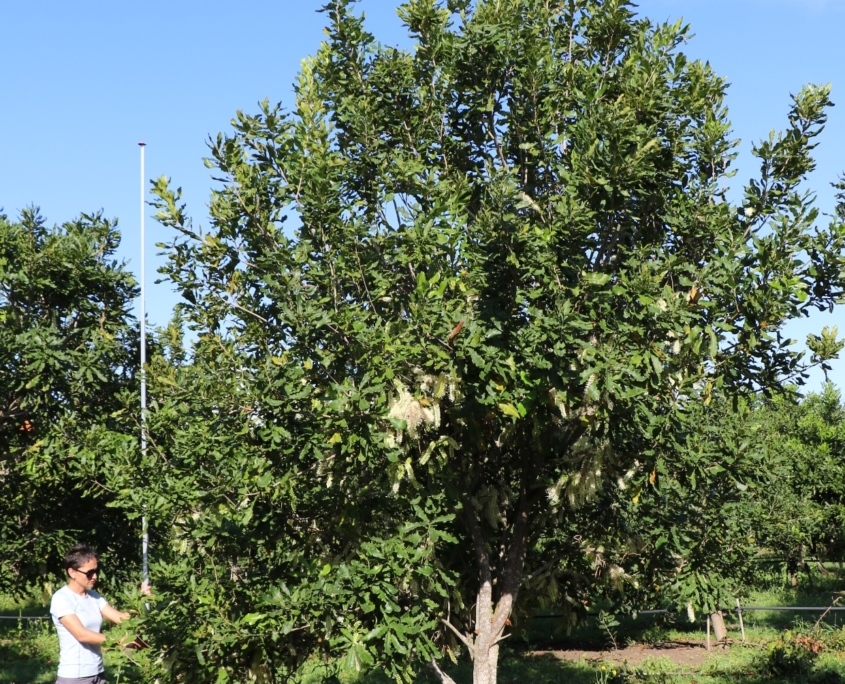
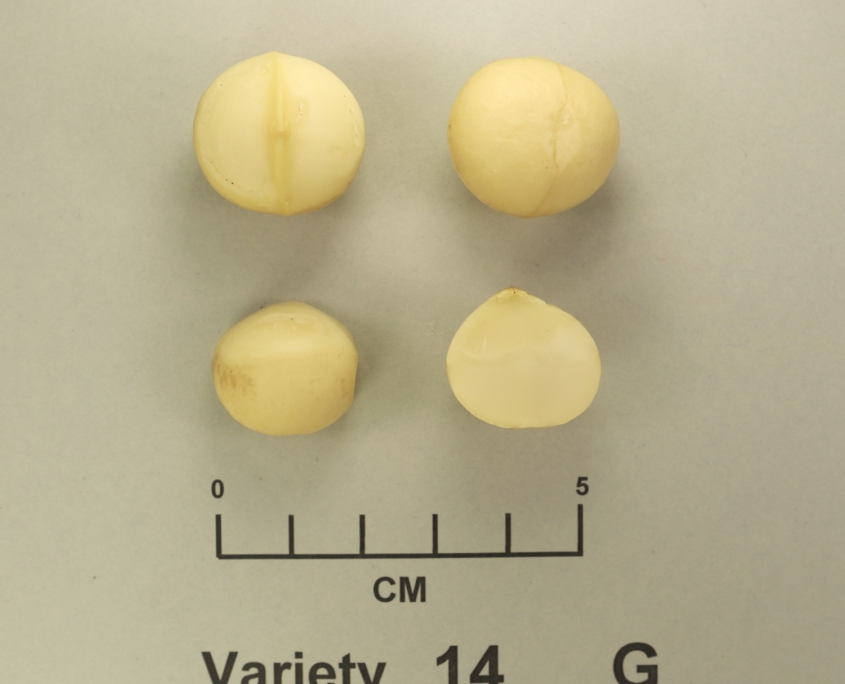
Variety G ::
$61,555
Total kernel yield per hectare at Bundaberg
$62,235
Total kernel yield per hectare at Alstonville

At Bundaberg, Variety G had the highest cumulative kernel recovery over nine years and the third-highest kernel canopy efficiency. At Alstonville (a site without irrigation), it performed almost as well as at Bundaberg, and better than the varieties 246, 344 and 741.
Using a nut-in-shell (NIS) value of $4/kg, total kernel yield per hectare over the nine-year trial period was $61,555 at Bundaberg, and $62,235 at Alstonville (cumulative NIS yield x percentage kernel recovery. This is for 312 trees per ha. Please note that the average NIS price over the past 11 years is $4.72 per kg)

Figures 1 and 2 below show the nut-drop pattern in 2016 for Variety G at the trial sites at Bundaberg and Alstonville. These patterns were consistent over the nine-year trial period so provides a good indication of nut drop.
In trials, Variety G performed well at Bundaberg and at Alstonville, so it seems it can be grown over a wide geographical range.
Variety G has been carefully assessed for 21 years – nine years of regional variety trials and, before that, 12 years in progeny blocks.
This testing extends to trees used as budwood sources, which have been DNA tested for trueness to type. Blocks of trees have been planted as future sources of budwood for grafting in both Queensland and New South Wales.
Australasian Plant Genetics (APG) will make every effort to provide budwood for grafted trees from approved budwood suppliers, and large amounts of budwood are available.
Variety G commercialisation is managed by APG.
While the association expects that Variety G will perform well in most growing areas, it recommends that its suitability to local conditions and to individual farm management systems be tested by growers by planting trial plots.
Trees can be ordered from nurseries licensed by APG. Crop inputs need to be matched to expected higher yields.
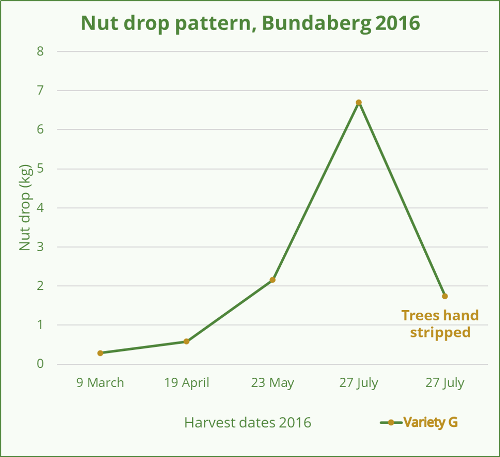
Figure 1. Nut-drop pattern for Variety G at Bundaberg, 2016.
Note that the two points for 27 July reflect the fact that nuts were harvested from the floor (highest point) and stripped from the trees on the same day.

Figure 2. Nut-drop pattern for Variety G at Alstonville, 2016.
Note that the two points for 29 August reflect the fact that nuts were harvested from the floor (highest point) and stripped from the trees on the same day.
Variety G has Protection under the Australian Plant Breeders’ Rights Act (PBR Act) and is currently licensed to 14 nurseries, distributed from New South Wales to Mackay in Queensland.
A royalty of $4.00 (plus GST) will be added to tree price and purchasers will be required to sign a Non-Propagation agreement before collecting grafted trees.
Please note that there are significant royalty discounts to $3.00 per tree (plus GST) for large orders of more than 5000 trees and also for high-density plantings.
Part of the royalty collected (less management fees) will be passed back to the Australian macadamia industry to be used for RD&E projects, which are determined by the industry and Hort Innovation.

The project Macadamia regional variety trials series 4 has been funded using the macadamia research levy and contributions from the Australian Government. Hort Innovation is the grower-owned, not-for-profit research and development corporation for Australian horticulture.
This fact sheet was developed by APG & AMS in conjunction with Dougal Russell and his team from the Queensland Department of Agriculture and Fisheries.
 © Queensland Department of Agriculture and Fisheries
 © Queensland Department of Agriculture and FisheriesVariety R